
How to Store Cigars Properly for Lasting Freshness
Last Updated: October 25, 2026
Quick Summary
To store cigars properly, keep them at 65% to 75% relative humidity (70% is the classic target) and between 22°C and 25°C in a seasoned humidor with a calibrated hygrometer. Without a humidor, use an airtight container with a two-way humidity pack for short periods only.
- Season a new humidor over three to five days until the hygrometer holds steady before adding cigars.
- Use distilled water only in the humidifier, since tap water leaves mineral deposits and can introduce mold spores.
- Run a salt test to calibrate your hygrometer; a calibrated gauge should read about 75%.
- Never store cigars in the fridge, freezer, car, or garage.
- For one to three months without a humidor, use an airtight container with a two-way pack in a cool closet.
Table of Contents
- Why Proper Cigar Storage Matters
- The Best Humidity for Cigar Storage
- Getting the Temperature Right
- How to Use a Cigar Humidor
- How to Store Cigars Without a Humidor
- How Long Cigars Last in a Humidor
- Troubleshooting Humidity and Temperature Problems
- Choosing Your First Humidor
- Frequently Asked Questions
Why Proper Cigar Storage Matters
Cigar storage is the practice of keeping cigars at a stable humidity and temperature so they stay fresh, burn evenly, and hold their flavor.
At Lipstick and Smoke, we hear the same story from women new to cigar lounges: they buy a beautiful stick, leave it in a handbag for a week, and it smokes hot and bitter.
Proper storage protects three things:
- Moisture balance, so the wrapper does not crack
- Flavor, so the oils stay inside the leaf
- Burn quality, so the draw stays even
Cigars are a natural product. They keep changing after they leave the roller's table. Control the air around them and you control how they age.
If you also worry about the smell lingering on your hair after a lounge night, that is a separate issue, and we cover it in our guide on how to remove cigar smell from hair.
The Best Humidity for Cigar Storage
The best humidity for cigar storage sits between 65% and 75% relative humidity, with 70% as the classic target.
Relative humidity means the amount of water vapor in the air compared with what that air could hold at its current temperature (Discussion on Humidity).
Here is what each range does:
- Under 60%: wrappers crack, flavor flattens, draw gets harsh
- 65% to 69%: a drier smoke, popular with smokers who dislike a damp draw
- 70%: the traditional middle ground
The old advice was simple: 70% humidity at 70°F. That rule still works as a starting point.
Getting the Temperature Right
Temperature should stay between 22°C and 25°C, which is roughly 70°F to 75°F.
Watch out: a humidor near a radiator, a sunny window, or an air-conditioning vent will swing in temperature daily. Those swings matter more than most guides admit.
- Keep the humidor off the floor and away from outside walls
- Avoid kitchens and bathrooms, where humidity is unpredictable
- Never store cigars in a car or garage
Seasonal shifts are the sneaky part. Winter heating dries indoor air, so your humidifier works harder. Summer air conditioning pulls moisture out fast.
How to Use a Cigar Humidor
Using a cigar humidor means seasoning it first, then filling the humidifier, loading the cigars, and checking the hygrometer regularly.
Follow these steps:
- Season the humidor. Wipe the cedar lining lightly with distilled water, or place a small dish of distilled water inside. Close the lid and leave it for a day or two. For a new or long-dormant humidor, a common pattern is to repeat this over three to five days until the hygrometer holds steady near your target before any cigars go in.
- Fill the humidifier. Use distilled water only. Tap water leaves mineral deposits that clog the foam and can introduce mold spores.
- Mount the hygrometer. Most humidors, including ours, ship with a hygrometer that attaches with a sticker. Place it where you can read it through the lid, and keep it away from the humidifier so it reads the air the cigars actually sit in.
- Calibrate the hygrometer before you trust it. Many analog gauges read a few points off. Run a salt test: put a bottle cap of damp (not wet) salt in a sealed bag with the hygrometer, wait six to eight hours, and note the reading. A calibrated gauge should read about 75%. If yours reads 71%, you know to add four points to every future reading, or replace the gauge with a digital model.
- Let it stabilize. Close the lid and wait until the reading holds steady before adding cigars. Adding cigars to a humidor that has not settled just makes the gauge chase a moving target.
- Load the cigars. Leave a little space between them so air moves, and keep them out of direct contact with the humidifier.
- Check weekly. Refill the humidifier when the reading drops, and re-run the salt test every few months or whenever the reading looks suspicious.
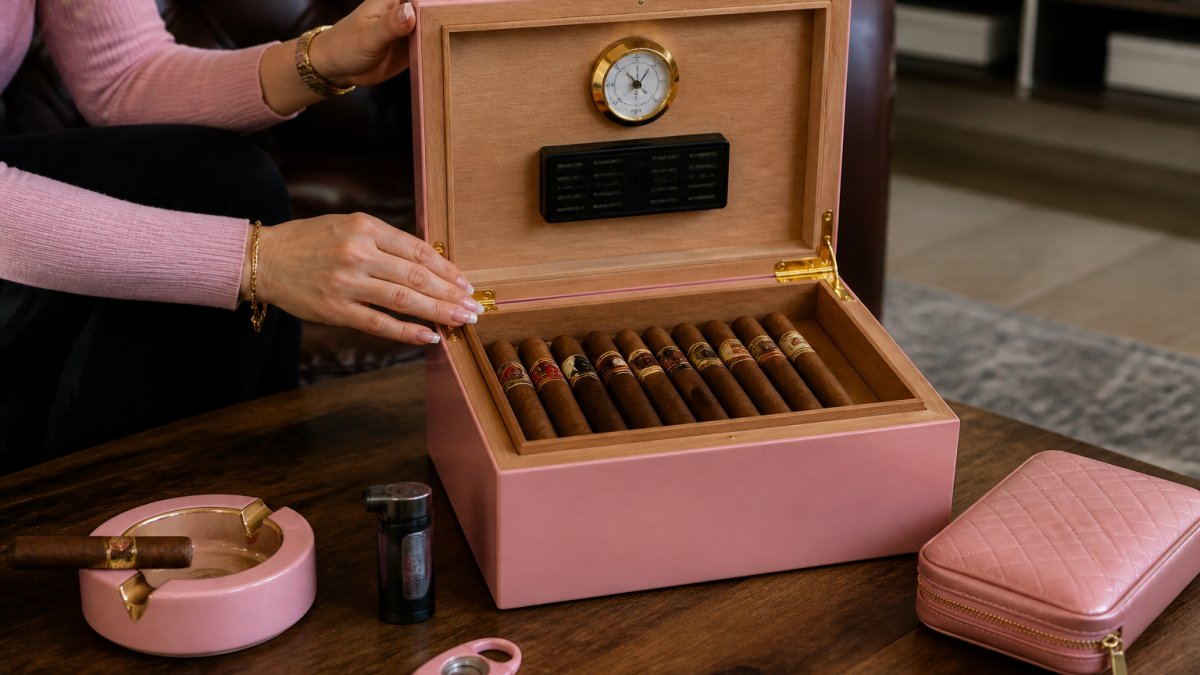
A cutter belongs in this routine too. Trim the cap cleanly before you smoke, and the draw improves immediately.
Maintenance is where most humidors fail. A common pattern is to refill the humidifier on a schedule rather than waiting for a dry reading, to wipe the cedar only when seasoning a new box (not routinely), and to air the humidor briefly if the reading climbs above target. If you live in a climate with big seasonal swings, expect to adjust your refill cadence at the start of winter and summer rather than keeping the same routine year-round.
How to Store Cigars Without a Humidor
Storing cigars without a humidor is possible for short periods using an airtight container, a humidity pack, and a cool, dark spot.
Here is the method:
- Choose a clean airtight container or a heavy zip-lock bag. Food-grade plastic is fine; avoid containers that held strong-smelling food.
- Add a two-way humidity pack rated for the humidity you want, a 69% or 72% pack is a common starting point for short-term storage.
- Place cigars inside, leaving a little air space so the pack can work.
- Keep the container out of sunlight and away from heat.
- Open it briefly every few days to exchange air, especially in warm rooms.
A factory box or cigar box can work as a temporary home if you seal it inside a larger bag with a humidity pack.
For travel, a dedicated case beats a bag every time.
Match the method to the duration. This is where most short-term storage advice falls short, so use this as a quick guide:
- A few days (up to about a week): a sealed zip-lock bag with a humidity pack, or a cigar case, is enough. Check the pack is still pliable before you rely on it.
- Several weeks (one to three months): an airtight container with a two-way pack, kept in a cool closet, holds steady better than a bag. Open it briefly every few days and replace the pack when it stiffens.
- Longer than a few months: move to a seasoned humidor or a larger airtight container with a calibrated hygrometer. Short-term containers work, but without a gauge you are guessing, and guessing is how cigars drift dry.
Compare the options at a glance. Each method trades reliability against maintenance:
- Humidor: best long-term stability and the only method built for aging, but needs seasoning, refilling, and calibration.
- Airtight container with packs: reliable for weeks to a few months, low maintenance, but no built-in gauge unless you add one.
- Zip-lock bag with a pack: fine for days, weakest seal, best for travel or a single evening.
- Factory box: good for keeping cigars in their original grouping, but only works as storage when sealed inside a larger bag with a pack.
A practical habit: keep one humidity pack and one small airtight container on hand even if you own a humidor.
How Long Cigars Last in a Humidor
Cigars last for years in a properly maintained humidor, and many improve over the first few months as they settle. The key word is maintained. A humidor that drifts dry will shorten that window fast.
Rough guide by situation:
- Days to a week: a sealed bag with a humidity pack is fine
- One to three months: a seasoned humidor or an airtight container with packs
- Six months to several years: a humidor with steady humidity and regular checks
- Aging for flavor: years, at the higher end of the humidity range
Cigars do not have a strict expiry date. They have a condition. Keep the humidity and temperature stable and a cigar can sit for a long time.
Troubleshooting Humidity and Temperature Problems
Most storage problems show up as a few clear symptoms. Match the symptom to the cause and the fix is usually simple.
| Problem | Likely Cause | Fix |
|---|---|---|
| Cigars feel dry, wrapper cracks | Humidity too low, humidor not seasoned | Re-season, refill humidifier, check hygrometer |
| Cigars feel spongy, burn poorly | Humidity too high | Reduce humidifier water, add dry cedar, air the box |
| White fuzzy spots | Mold from excess moisture | Remove affected cigars, lower humidity, clean the box |
| Hygrometer reading seems wrong | Gauge out of calibration | Run a salt test and adjust or replace |
| Humidity swings daily | Heat source nearby, lid opened too often | Move the humidor, limit opening |
| Cigars taste bitter | Stored too dry or too warm | Stabilize at 65% to 70% and 22°C to 25°C |
A common mistake is adding water to fix a low reading without checking the temperature first. If the room got warmer, the humidity reading will fall even with the same amount of water in the humidifier.
Choosing Your First Humidor
Choosing a first humidor comes down to size, seal, lining, and the extras included.
What to look for:
- Cedar veneer lining to help hold humidity
- A hygrometer so you can monitor the reading
- A humidifier sized for the box
- A movable divider to keep cigars from rolling
Our Puff Purple humidor and the Pinkkfire humidor both come with a cedar veneer lining, a hygrometer, a humidifier, and a movable wooden divider.


Keep different cigar types separated. Strong cigars can pass flavor to mild ones over time, so use the divider and group similar sticks together.
Frequently Asked Questions
Is it okay to keep a cigar in the fridge?
A refrigerator is too cold and too dry for cigars. The low temperature slows the natural oils that give a cigar its flavor, and the dry air pulls moisture out of the tobacco, leaving it brittle and harsh. Fridges also carry food odors that tobacco absorbs easily. For short-term storage, a sealed container with a humidity pack at around 69% to 72% relative humidity is a far better choice than the fridge.
What humidity should cigars be stored at?
Most cigars smoke best between 65% and 72% relative humidity, with 69% to 70% being the common sweet spot. The old 70/70 rule (70% humidity at 70°F) is a useful starting point, but many smokers prefer slightly lower humidity for a cleaner burn. If your cigars feel spongy or draw poorly, drop toward 65%. If they crack or burn hot, raise the humidity a few points and recheck with a calibrated hygrometer.
How long can cigars stay fresh without a humidor?
Without any humidity control, a cigar can dry out in as little as a few days to two weeks depending on your climate. In a sealed zip-lock bag or airtight container with a humidity pack, cigars stay smokeable for several weeks to a few months. For anything longer than a month, use a proper humidor or a sealed container with a hygrometer so you can monitor the relative humidity and top it up when needed.
Can you store cigars in their factory boxes?
Yes. Factory boxes and original cigar boxes are made of thin wood that buffers humidity reasonably well, so they work as a short-term home for cigars. Keep the box closed and place it inside a humidor or sealed container rather than leaving it out in the open. If you mix different cigars in one box, separate them with the box's dividers or a cedar sheet to stop stronger wrappers from affecting milder ones.
Storing cigars properly takes one habit: check the humidity and temperature, then adjust. That is the whole game. Lipstick and Smoke makes the setup part easy, with cedar-lined humidors that include a hygrometer and humidifier, travel cases that protect cigars on the move, and precision cutters for a clean draw. Get started with Lipstick and Smoke and keep every cigar fresh from the first light to the last.
